In times of rising feed prices and shrinking dairy margins, dairymen often critically review their feed rations with their nutritionists and adjust with the goal to cut costs. There are a number of different ratios that are available to evaluate, and each has its own strengths and weaknesses. Let’s start by evaluating a couple of the more common ones used. Feed cost/cow/day
By using this ratio exclusively, you can focus on trying to produce or purchase ingredients at a lower cost, i.e. least cost rations. However, the weakness of this ratio is that it does not look at milk production. Although you may be able to reduce your feed cost, you may also end up reducing your milk income. Also remember that feed that is already in inventory is sort of a sunk cost and the only way to recover this expense is to feed out these ingredients. Purchasing ingredients and allowing inventories to grow beyond necessary can be hard on cash flow even if it is a less expensive ration for the cow today.
Feed cost/cwt milk sold
This ratio allows you to determine how efficient your feed cost is relative to your milk production. While this ratio does combine feed cost with milk production and helps you determine a large percentage of your cost of production, it does not help you evaluate earnings after feed costs are considered.
Using the above ratios, let’s consider an example that compares feed cost between two dairies with the above ratios and see what conclusions can be drawn:
What is interesting in this example is the two dairies were feeding the same TMR and they were valuing the forages, grains and additives exactly the same. Their feed costs differ so widely because of milk production. Every cow has a certain amount of feed she needs to eat for maintenance, and as milk production increases, the maintenance feed needs are spread over more pounds of milk, allowing feed cost to decrease and the feed efficiency to improve.
The point is this: While prices paid for ingredients are important, they are not the only driver of overall profitability. If you want to determine your ability to buy feed “properly,” compare prices that you pay for specific ration ingredients. If you want to compare the ability to generate earnings from feed, then evaluate income over feed cost. Income over feed cost/cow/day
This ratio is the one to evaluate if you are looking at your herd’s ability to generate earnings to pay fixed expenses. It has the advantage in that it is able to combine the cost of feed ingredients, feed efficiency, milk production and milk component value. Its weakness is that it can be influenced by swings in milk price and percent components in the milk. However, this weakness can be compensated for if a standardized milk value is used and the milk production is corrected for butterfat and protein by using energy corrected milk.
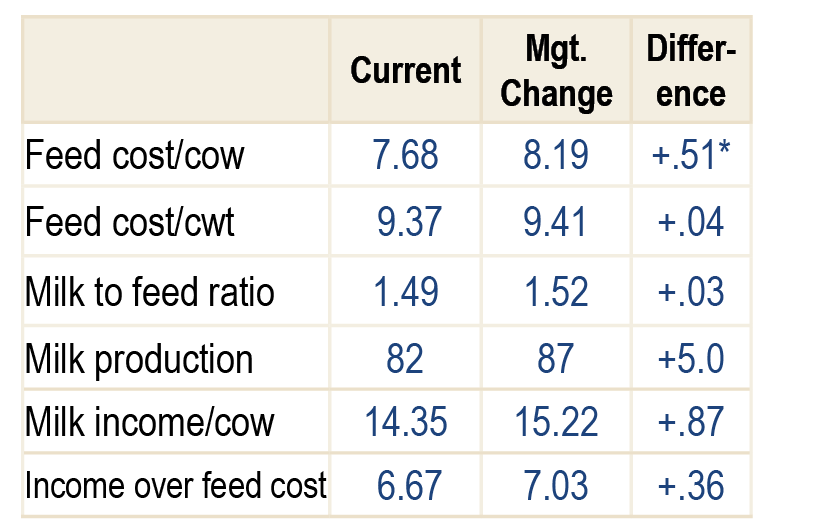
If we use an example of a dairy that implemented a management change that cost an additional $.20/cow/day but resulted in a 5-pound milk production response, we end up with the following ratios:
*The $.51/cow/day difference is the result of a $.20/cow/day increase in ingredient cost and a $.31/cow/day increase as a result of an increase in dry matter intake resulting from additional milk production.
If you would have finished evaluating this management change once the feed cost/cwt was determined to be higher, you would have missed the opportunity to improve your earnings/cow by $.36/cow/day.
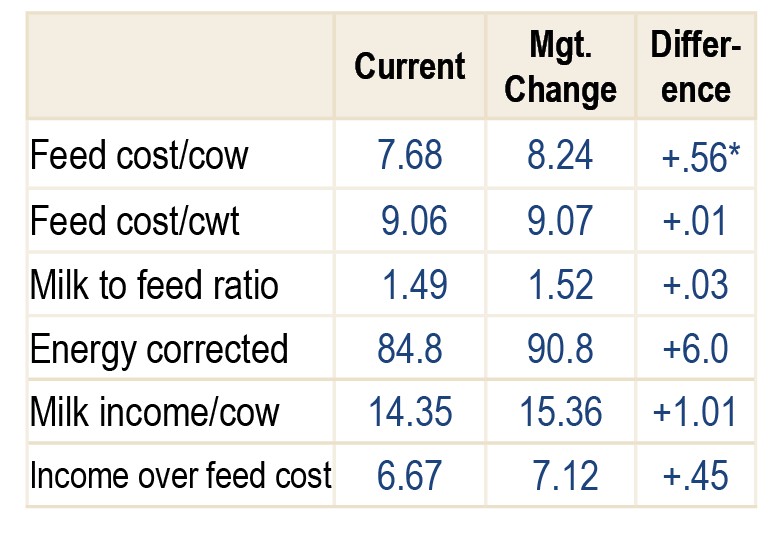
Rarely when we make a change in rations do we not also see a change in the milk components. If you add the step of using energy corrected milk with a standardized milk price and saw an improvement in the butterfat by .05% and the protein improves by .03% and the 5 pounds of milk, then we end up with the following ratios:
*The $.56/cow/day difference is the result of a $.20/cow/day increase in ingredient cost and a $.36/cow/day increase as a result of an increase in dry matter intake resulting from additional milk production.
The change in the milk components can have a large impact on income over feed cost and should be included in income over feed cost valuation.
In summary, the key to understanding financial ratios associated with feed is that no one ratio contains all the answers. Avoid making a management decision that may ultimately decrease your dairy’s profits because you were told that “your feed costs are too high.” You need to understand that increasing energy corrected milk production dilutes the maintenance feed cost and increases profits, and this is why using income over feed cost/cow/day is a good ratio when evaluating rations.


 Print Page
 Email to a Friend