Ag experts join Edge, DBA to discuss market outlook
Monday, June 13, 2022
(0 Comments)
By Travis Senn, digital communications manager  To say times have been turbulent in recent years feels like the understatement of the century. When it used to take decades to fill chapters in history books, it now seems to take only a few years if not months because of stories on COVID-19, geopolitical battles and more. To say times have been turbulent in recent years feels like the understatement of the century. When it used to take decades to fill chapters in history books, it now seems to take only a few years if not months because of stories on COVID-19, geopolitical battles and more. Whether we like it or not, today’s dairy farmer works in a global space. Last year, ag exports reached record levels, and 2021 saw continued growth (and reliance) on export markets.
This presents a massive opportunity for dairy farms to continue growing to meet the demand of a global market. Yet, expanding U.S. dairy’s footprint means exposure to a host of outside variables, including global politics. Recently, Edge and the Dairy Business Association hosted a market update webinar featuring experts who shared insights into what the future might hold. Russia-Ukraine war  Mark Purdy is the chief operating officer for Aimpoint Research, a global strategic intelligence firm specializing in agri-food. He provided the latest on the Russia-Ukraine war. Mark Purdy is the chief operating officer for Aimpoint Research, a global strategic intelligence firm specializing in agri-food. He provided the latest on the Russia-Ukraine war. Purdy explored the impacts on agricultural production regions in Ukraine. He noted that not everyone is turning their backs on Russia due their actions, namely China and India. As a result, fertilizer supplies are being impacted ― 46% of global nitrogen production comes from China, Russia and India. Meanwhile, 45% of phosphorus production and 50% of the potash production come from those same countries.
 Mike North, principal with EverAg ― a commodity risk management and grains solutions partner, explained how significant an impact Ukraine has on global grain markets; the country ranks first in global sunflower oil production, second in barley production, third in both rapeseed and wheat production and fourth in corn production. Mike North, principal with EverAg ― a commodity risk management and grains solutions partner, explained how significant an impact Ukraine has on global grain markets; the country ranks first in global sunflower oil production, second in barley production, third in both rapeseed and wheat production and fourth in corn production. “Their significance in the global economy has an impact that ripples all the way back to the traditional landscape that we know,” North said.
North noted that it is not as simple as evaluating what the Ukraine will produce or not; there is still grain sitting on the ground that is not able to leave the country due to the war. The 2021-2022 crop year was the highest on record there. It’s estimated that there are still 14 to 15 million metric tons of corn left to export in Ukraine ― equivalent to about 600 million bushels or nearly 40% of U.S. inventory available in reserve through the end of the marketing year. “With global buyers wondering where to source grain from, the United States is really that next-best partner,” North noted. Effects on feed While demand for U.S. grain grows, North warned of potential dangers ahead on the production side of the equation. Droughts have engulfed the western U.S. ― especially the Southwest. If that extends eastward like it did last year, it could spell trouble for feed buyers. However, not all areas have experienced drought. North and South Dakota serve as primary examples. Last year, hot and dry conditions adversely affected growing conditions. This year tells another story. “While we watched the Dakotas burn up last year, they are now swimming in excess moisture,” North said. “Bottom line is there are different issues preventing planting at our normal pace.” North explained planting progress using corn as an example. The five-year average pace for this time of year is about 77% of corn planted; 2022 stands at 72%. Despite the slowed planting, warm temperatures have helped emergence. North said if things continue, emergence may catch up to or surpass prior-year levels. Still, the late planting threatens total corn acres. In turn, prices are reaching historic highs. North noted that corn futures are pushing $8 per bushel ― a mark seen just once before. Even new crop prices are up, with December corn trading over $7.30 per bushel. With so many variables, North expects the markets to remain volatile for the near future. Milk production trends  Dr. Marin Bozic explored where dairy markets are headed. Bozic is a nationally recognized dairy economist who also serves in an advisory role on the Edge board of directors. Dr. Marin Bozic explored where dairy markets are headed. Bozic is a nationally recognized dairy economist who also serves in an advisory role on the Edge board of directors. He showed recent milk production trends, noting that the U.S. has seen six consecutive months of year-over-year declines. He also mentioned the contrast between this timeframe and the 26-month period prior to it, in which U.S. milk production grew year over year for 25 of those months.
Bozic attributed the decline to a combination of factors. “The U.S. herd currently has about 100,000 fewer cows than we did a year ago. On top of that, milk per cow is not growing the way it typically has. When you combine lower productivity with fewer cows, it’s not surprising that we have less milk in the country.”
Bozic said this decline in milk production is helping buoy higher milk prices but is not the primary driver. “Major exporters ― New Zealand, Australia, Argentina, Europe ― are all having issues. Nobody is growing right now ― all for varying reasons.” Bozic pointed to the increase in global feed prices, but other factors are at play, too. While New Zealand used to grow its national herd quite aggressively, it shifted focus to growing cow productivity. Europe will have issues with feed and fertilizer not only due to the Russia-Ukraine war but also due to environmental restrictions. With other exporters limited in growth potential, Bozic said the U.S. is in a prime position to serve global buyers. Producer price differentials Domestically, Bozic discussed producer price differentials (PPDs) and showed data explaining the difference between the Class III and Class IV milk prices. Historically, when Class III becomes much greater than Class IV, farmers often see negative PPDs. Bozic said logic would suggest that when Class IV is much greater than Class III, farmers should expect to see those dollars added back into their milk check. Yet, that is not necessarily the case. “When Class III is the highest, cheesemakers will often de-pool,” he said. “When Class IV is highest, butter and powder plants de-pool.” In the Upper Midwestern Federal Milk Marketing Orders (FMMOs), Class III volumes vastly outweigh Class IV. Bozic explained that there simply isn’t enough money in the system to provide that additional compensation. Bozic said this relationship has implications for dairy farmers ― especially those who utilize risk management. “You should really tie your risk management strategy based upon the product mix of the company you ship your milk to rather than the order in which you operate. That’s what will really drive your milk check.” The outlook for dairy Bozic also focused on his outlook for dairy markets. He said that due to feed hedging, 2022 has been a more profitable year than most with higher milk prices. However, the impacts noted by North and Purdy may provide a shift as those contracts expire. “They say, ‘The best cure for high prices is high prices,’ and that’s true,” Bozic said. “But right now, we have a very dampened response from our global competitors.”
While Bozic expects feed costs to eat into margins for dairy farmers, he suggested this will also limit the appetite for aggressive expansion that typically occurs when milk prices are so high. He noted the difference between milk markets today versus many years ago. “Years ago, shocks were mostly predictable,” he said. “It was mostly dairy supply driving the cycle. You make a lot of money, you add cows, there are too many cows and milk prices go down. That hasn’t been the case for 10-12 years. Recession, drought, COVID ― the next crisis, if it comes, may come in a hurry.” 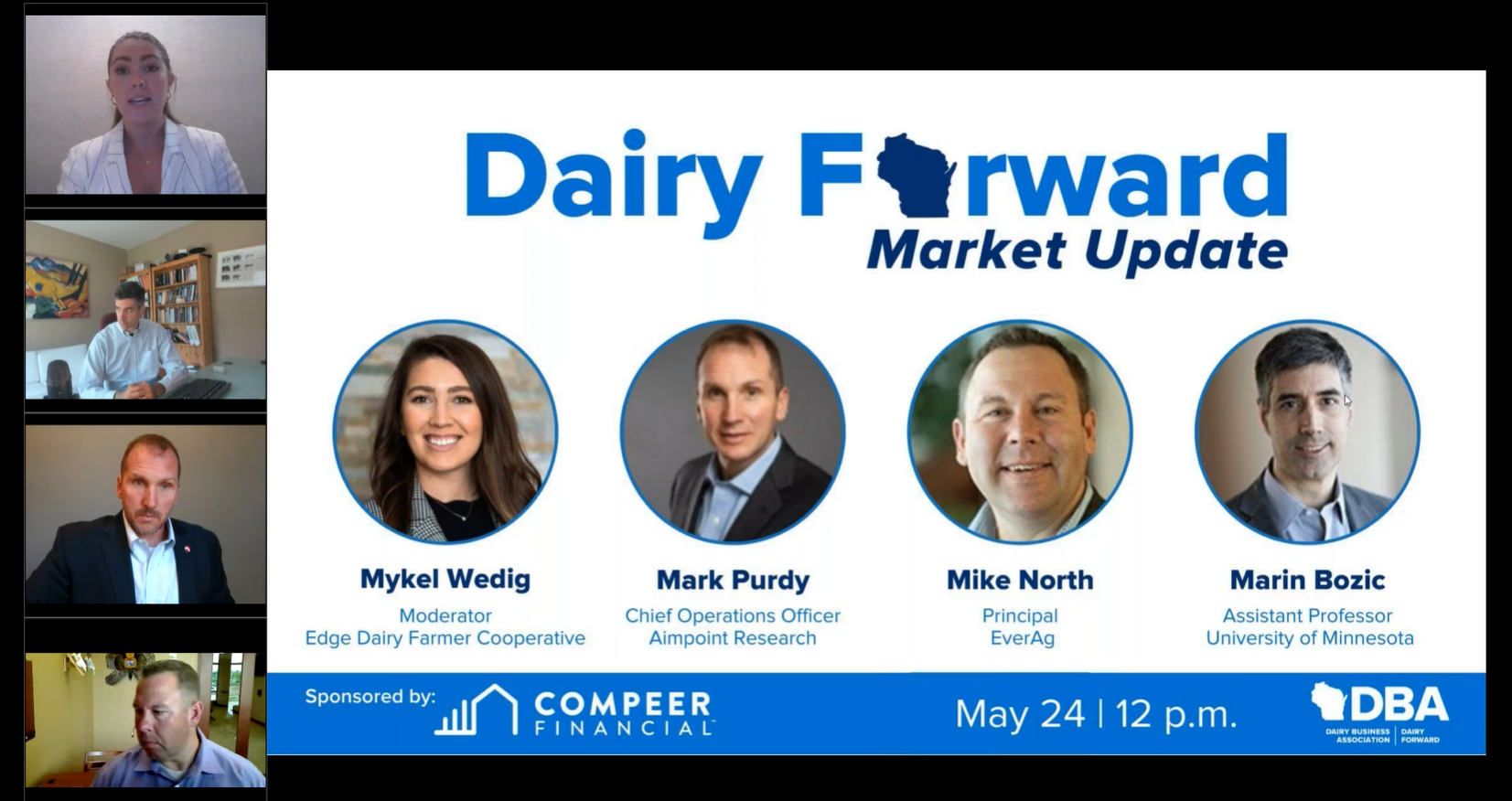
|


 Print Page
 Email to a Friend